Hooga ULTRA1500: what the flagship tower buys
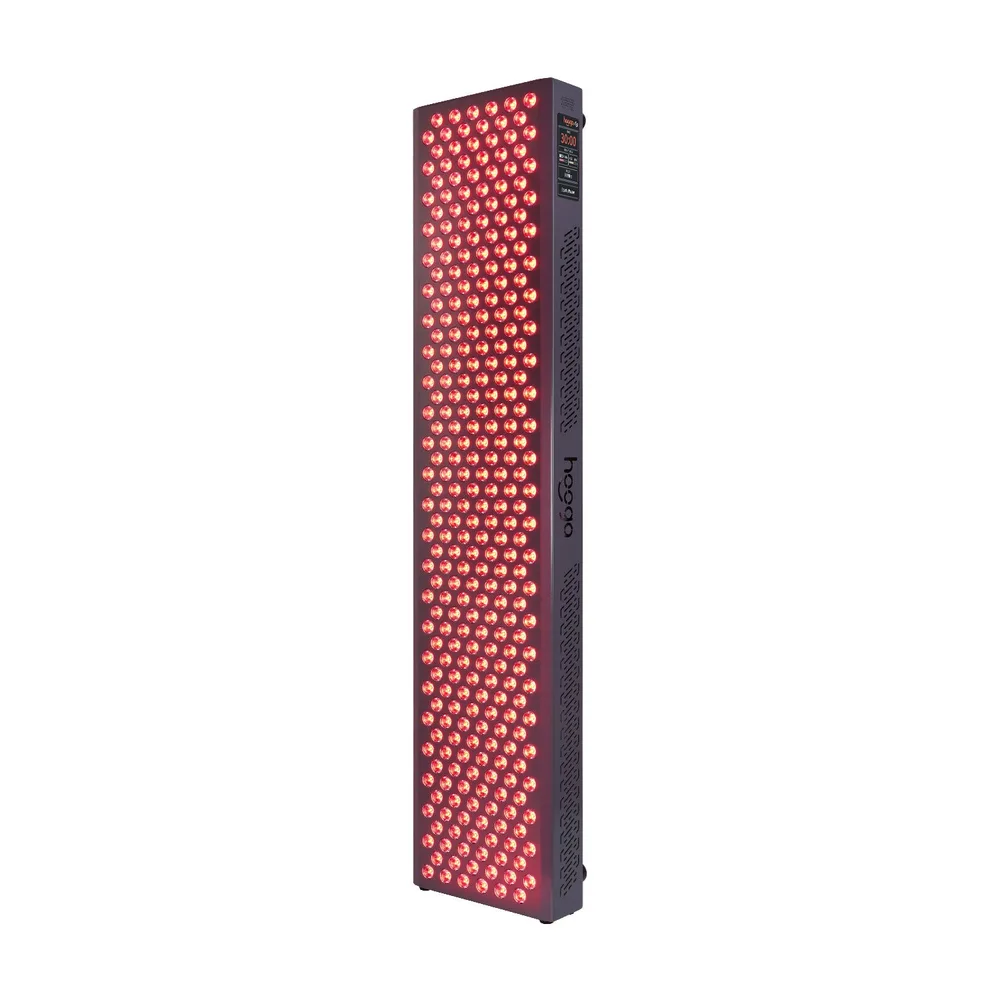
Hooga made its name selling red light panels that undercut the boutique brands without falling apart. The ULTRA1500 is a different pitch: a 300-LED tower listed on Hooga’s own site for close to $1,400, aimed at buyers who have outgrown a desktop panel and want a single unit covering most of a standing body. That price sits $350 to $500 above capable mid-tier towers, including two we cover in this category, so the working question is what the gap buys.
What the buyer gets
The panel stands 39.5 inches tall by 8.6 inches wide and 2.5 inches deep, weighs 28 pounds, and Hooga rates its maximum coverage at 60 by 29 inches, which reads as head to mid-thigh on most adults at a workable distance. Inside sit 300 quad-chip 5-watt LEDs. Each diode carries all four wavelengths, 630 and 660 nanometer red plus 810 and 850 nanometer near-infrared, so the mix stays uniform across the panel face instead of alternating between red-only and infrared-only diodes the way most competitors do.
Control is where the spec sheet turns unusual for this size of panel. A bundled remote runs everything: the red and near-infrared banks dim independently, the timer sets anywhere from 1 to 30 minutes, and a pulse mode flickers the LEDs at any frequency from 1 to 9999 Hz. Four cooling fans protect diodes rated for more than 50,000 hours, and the beam angle is a focused 60 degrees. Power draw is 478.5 watts, which works out to around four cents per half-hour session at typical residential electricity rates, or roughly $15 a year if you run it daily. Hooga backs the hardware with a 3-year warranty and a 60-day trial.
Where it earns flagship money
The quad-chip array is the real upgrade. Cheaper panels, including Hooga’s own lower tiers and the two mid-tier picks we cover, split their diodes between wavelengths, so the light hitting any one spot depends on which diodes happen to face it. Putting all four wavelengths on every diode removes that lottery, and the separate dimming for red and near-infrared banks means you can run one, the other, or any mix, at any brightness. No mid-tier panel in our lineup offers that. The pulse mode is rarer still, and whatever you think of pulsing, the hardware executes it with a precision most brands do not attempt.
Hooga states 165 mW/cm2 of irradiance at 6 inches, the highest claim among our picks. Keep a caveat taped to that number. Mito Red Light, to its credit, publishes two figures for its comparable MitoMEGA: over 165 mW/cm2 on the consumer solar meters most of this industry uses, and just over 74 mW/cm2 in independent lab testing. Hooga publishes one number without naming the meter, so treat 165 as a spec for comparing Hooga models against each other, not as verified output.
The support terms do real work at this price. Three years of warranty beats the two years typical of the category, and the 60-day trial means a buyer who mounts it, runs it, and regrets it can send it back. Owner accounts, paraphrased, describe build quality as excellent and full-brightness output as intense enough that they recommend settling distance and session length before committing to long runs; one buyer who stepped up from a budget panel named the quad-chip design as the reason to move.
Where it falls short
Twenty-eight pounds is a lot of panel to hang. A hollow-core door or a flimsy over-door hook is not a plan; budget for a proper stand or a wall anchor into studs, and factor that cost in, since stands for towers this size are not cheap. The 30-minute timer cap also means longer sessions need a restart, a small but recurring annoyance on a panel this configurable.
The track record is thinner than the brand’s reputation suggests. This exact variant has only a handful of owner reviews, with most of the shared Hooga listing family’s feedback earned by different panels. Paperwork is the other gap: Bestqool’s cheaper Pro300 arrives with FDA Class II registration, ETL, CE, and RoHS marks plus FSA/HSA eligibility, while the ULTRA1500 spec sheet leads with performance numbers and lists none of that. If you planned to pay with an FSA card, check first. There is also no manufacturer video of the unit running, so you are buying off photos and the trial period.
Who it fits
Buy the ULTRA1500 if you want near full-body coverage from one tower, you will mount it properly, and independent wavelength control or pulse tuning is something you will actually touch. The warranty and trial make the thin variant-level review history a tolerable risk. Skip it if you would leave the settings at 100% and never open the remote’s menu, because the mid-tier panels deliver similar coverage at a much lower price, and that difference buys the stand you were going to need anyway.
The spec sheet
| LEDs | 300 quad-chip 5W LEDs |
|---|---|
| Wavelengths | 630nm, 660nm red + 810nm, 850nm near-infrared |
| Stated irradiance | 165 mW/cm2 at 6 inches (maker-measured) |
| Power draw | 478.5W |
| Size / weight | 39.5 x 8.6 x 2.5 in, 28 lb |
| Rated coverage | Up to 60 x 29 in |
| Controls | Remote, separate red/NIR dimming, 1-30 min timer, 1-9999 Hz pulse mode |
| Cooling / lifespan | 4 fans, 60-degree beam angle, 50,000+ hour LEDs |
| Warranty | 3 years plus 60-day trial (manufacturer) |
- Four wavelengths on every diode, red and NIR dimmable separately
- Pulse mode from 1 to 9999 Hz plus a remote, rare at this size
- 3-year warranty and 60-day trial beat the category norm
- Sold by Hooga itself on both channels, so returns route to the maker
- 60 x 29 inch rated coverage from a single tower
- 28 lb tower needs a sturdy stand or a wall anchor into studs
- Very few owner reviews on this exact variant so far
- 165 mW/cm2 claim is maker-stated, not independently verified
- Timer caps sessions at 30 minutes
Pay for the control, not the irradiance number
The ULTRA1500 earns its price with control no mid-tier panel matches: four wavelengths on every diode, separate red and near-infrared dimming, and a pulse mode set to the hertz. A 3-year warranty and 60-day trial offset the thin variant-level review history. Ignore the 165 mW/cm2 headline when comparing brands, since nobody measures these numbers the same way. Buy it if you want one tower lighting most of your body and you will use the settings. Cheaper towers on this shelf cover a body too.
Hooga questions, answered once
Can the ULTRA1500 run red and near-infrared light separately?
Yes. The red bank (630 and 660 nanometers) and the near-infrared bank (810 and 850 nanometers) dim independently from the included remote. You can run either bank alone or mix them at any brightness, which most panels in this class cannot do.
Is the 165 mW/cm2 irradiance figure reliable?
Treat it as a marketing spec, not a lab result. Most brands measure with consumer solar meters that read high; Mito publishes both numbers for a comparable panel and its independent lab figure came in at less than half the solar-meter reading. Hooga's number is fine for comparing Hooga models against each other, but not for cross-brand shopping.
What does the ULTRA1500 cost to run?
It draws 478.5 watts at full power, so a 30-minute session uses about a quarter of a kilowatt-hour. At typical US residential rates that is roughly four cents per session, or around $15 a year with daily use.