Bestqool Pro300 red light panel: the modular tower
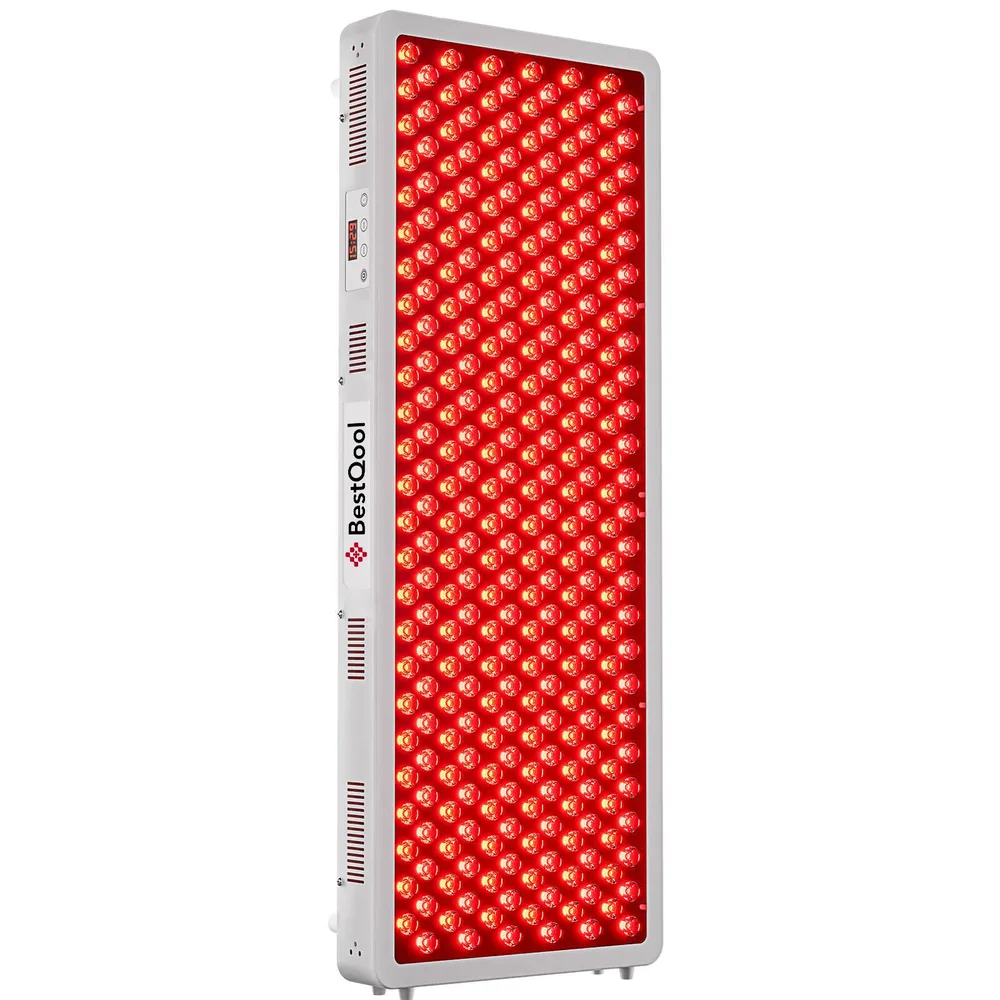
The flagship red light panel market has settled into a pattern: 300 LEDs, a tower form factor, and a price somewhere between a good mattress and a bad used car. Bestqool’s Pro300 plays in that bracket while undercutting most of it, landing well under a grand, and the spec sheet reads like it was written to pick fights. Four wavelengths where most towers carry two. A measured 500 watts of output backed by spectrometer footage instead of theoretical LED math. A splice system that turns two panels into a light wall. The question is whether those spec-sheet wins survive inspection, and a couple of them come with asterisks worth reading before checkout.
What the buyer gets
The Pro300 is a tower measuring 36.4 by 13.5 inches and 2.6 inches deep, carrying 300 dual-chip LEDs. Each diode pairs two emitters, either 630 with 940nm or 660 with 850nm, which is how the panel covers four wavelengths: two visible red, two near-infrared. The 940nm band is the rare one at this level; most competing towers, including Mito Red Light’s MitoMEGA 2.0, run a straight 660/850 split and stop there.
Bestqool states 106 mW/cm2 of irradiance at 3 inches and a cumulative 190.8 J/cm2 across a 30-minute session at that distance. Those are the maker’s numbers, taken close to the array, and the distance matters; more on that below. Effective coverage runs 46.5 by 17.4 inches at 6 inches out, enough for torso and thighs from a door hang. The whole unit weighs 19.11 pounds, which sounds unremarkable until you put it next to Hooga’s ULTRA1500 at 28 pounds. Over-door hooks and drywall anchors care about that difference.
Paperwork is thicker than the category norm: FDA Class II registration, IEC 60601, ETL, CE, and RoHS, and the maker lists the panel as FSA/HSA eligible. The warranty runs two years.
Where it earns flagship money
Three things separate this panel from the mid-tier boards it superficially resembles.
First, wavelength count. Dual-chip diodes covering 630, 660, 850, and 940nm give the Pro300 a spread that rivals reserve for pricier hardware or skip entirely. Whether four bands matter for your purposes is your call to research; as hardware, you are getting emitters most panels at this spend do not carry.
Second, documentation. Bestqool publishes a clip of a gloved technician running a handheld spectrometer and ruler across the lit array, with the spectral curve, center wavelength, and measured output shown on screen. That proves nothing beyond what the clip shows, but it beats the industry habit of multiplying LED count by chip wattage and calling the result output. The 500W figure is presented as measured, not theoretical, and the company also claims zero measured EMF at 6 inches.
Third, the splice system. Two Pro300s link into a single full-height array on the maker’s mobile stand. Mid-tier brands make you buy the bigger model up front; this design lets you start with half a wall and finish it later, which is a saner way to spread the spend than reselling a small panel to fund a big one.
Owner feedback backs the build story. Its listing carries the deepest owner-feedback base among the flagship towers we track, and the aggregated feedback describes a powerful, well-constructed unit with clear setup directions. The Gadgeteer’s October 2025 hands-on review praised the modular multi-panel design and the build quality.
Where it falls short
The irradiance figure needs an asterisk the size of the panel. Bestqool quotes 106 mW/cm2 at 3 inches. Hooga quotes 165 at 6 inches, and Mito publishes both an independent lab figure and a consumer-meter figure, also at 6 inches. Light intensity drops off steeply with distance, so a 3-inch measurement flatters the number against rivals measuring twice as far out. The panel is not weak; the comparison is just not apples to apples, and Bestqool picked the distance that reads best on a spec sheet.
Controls are basic. You get a timer, and that is roughly the end of the interface. Hooga’s similarly sized tower offers independent red and near-infrared dimming plus a pulse mode adjustable from 1 to 9999 Hz, all from a remote. If you want knobs to turn, this panel does not have them, and there is no way to run the red and near-infrared banks separately.
The two-year warranty is serviceable but trails Hooga’s three years with a 60-day trial. Diodes here are the long-lived part of any panel, so the gap is more about repair logistics than expected failure, yet flagship money usually buys longer paper than this.
Who it fits
Buy the Pro300 if you want the widest wavelength spread and the biggest verified owner base in this bracket, and if the splice-and-stand path to a full light wall matches how you expect to expand. It is also the easiest of the big towers to hang, at nearly nine pounds lighter than the Hooga.
Skip it if you want session-tuning controls, because Hooga sells dimming and pulsing for a few hundred dollars more. Skip it too if published measurement rigor at a standard distance is your deciding factor, since Mito’s third-party 6-inch lab numbers are the cleaner comparison point. And if you only plan to light a face-and-shoulders area, a half-size board costs a fraction of this and does that job; a 36-inch tower is money spent on coverage you would not use.
See it move
maker clip measuring the lit LED array with a handheld spectrometer, showing the spectral readout. Manufacturer video, self-hosted. Sourced August 19, 2026.
The spec sheet
| LEDs | 300 dual-chip LEDs (630+940nm and 660+850nm pairs) |
|---|---|
| Wavelengths | 630nm, 660nm, 850nm, 940nm |
| Stated irradiance | 106 mW/cm2 at 3 in; 190.8 J/cm2 after 30 min at 3 in (maker figures) |
| Measured output | 500W, shown in maker's spectrometer demo footage |
| Size / weight | 36.42 x 13.46 x 2.56 in, 19.11 lb |
| Coverage | 46.5 x 17.4 in effective at 6 in |
| EMF | 0 measured at 6 in (maker claim) |
| Modularity | Two panels splice into a full-height wall on the mobile stand |
| Certifications | FDA Class II registered, IEC 60601, ETL, CE, RoHS; FSA/HSA eligible |
| Warranty | 2 years (manufacturer) |
- Four wavelengths including 940nm where most rivals stop at two
- Splice system joins two panels into a full-height light wall
- Maker shows spectrometer footage, not theoretical wattage math
- Lightest big tower at 19.11 lb, easier to door-mount
- Deepest owner-feedback base in this bracket
- Irradiance quoted at 3 inches, flattering next to 6-inch specs
- No pulse mode or separate red/near-infrared brightness control
- Two-year warranty trails Hooga's three years with 60-day trial
The spec-sheet brawler with one asterisk
The Pro300 delivers hardware that towers costing hundreds more do not match: four wavelengths, a spliceable frame, and maker-published spectrometer footage behind its 500W claim. Read its irradiance number with the 3-inch caveat attached, and accept a bare timer interface plus a two-year warranty. For buyers planning a full light wall in stages, it is the smartest platform in this bracket; buyers who want dimming and pulse control should pay up for the Hooga, and small-area users should buy a smaller board.
Bestqool questions, answered once
Can two Bestqool Pro300 panels be joined together?
Yes. The Pro300 supports splicing, so two panels lock into a single full-height array, and Bestqool sells a mobile stand built for the combined unit. That lets you buy one tower now and expand to a light wall later instead of committing to the full setup up front.
Why does Bestqool measure the Pro300's irradiance at 3 inches?
Closer measurements read higher, since light intensity falls off steeply with distance. The stated 106 mW/cm2 at 3 inches is a legitimate maker figure, but rivals like Hooga and Mito quote at 6 inches, so the numbers are not directly comparable. Match the measurement distance before comparing panels.
Is the Pro300 FSA/HSA eligible?
Bestqool lists the Pro300 as FSA/HSA eligible, and the panel carries FDA Class II registration. Plan administrators make the final call on reimbursement, so confirm with yours before counting on those funds.