What recliner leather labels actually mean
Furniture listings use the word leather the way cereal boxes use the word natural. It appears on chairs upholstered in genuine top-grain hide, on chairs where only the seat is leather, and on chairs covered in ground-up scraps glued to fabric. The price gaps between these materials are enormous, and the labels are built to blur them. This guide decodes the vocabulary with real examples from recliners we have researched, so you know what you are sitting on before you spend four figures.
Top grain, the benchmark that ages well
Top-grain leather is genuine hide with the surface lightly sanded and finished for a uniform look. It is the standard for quality furniture leather, and the widely cited expectation is that well-kept top-grain upholstery lasts 15 years or more, improving with age as it picks up a patina instead of wearing out. Makers who use it say so plainly, because the material costs them real money and they want credit for it. That gives you a useful test: if a listing buries the material description or leans on vague phrasing with no grade named, assume the answer is less flattering than top grain. Genuine top-grain chairs sit at the top of the category’s price range, and in this case you get what you pay for.
Semi-aniline and splits, premium with a footnote
Semi-aniline describes the finish rather than the cut. The hide gets a light protective coat over the dye, enough to shrug off everyday scuffs while keeping the natural surface visible. You will often see it paired with splits, the lower layers of the hide left after the top grain is cut away. Hooker’s Duncan recliner is a clean example: its Kalahari Camel upholstery puts semi-aniline top grain on the primary surfaces, the parts you sit on and touch, with split hide elsewhere. That is a reasonable trade at the designer tier, and Hooker discloses it. The lesson carries across the category: even premium makers mix cuts, so the question is never just whether a chair is leather, but which leather, and where.
Leather match, read this label twice
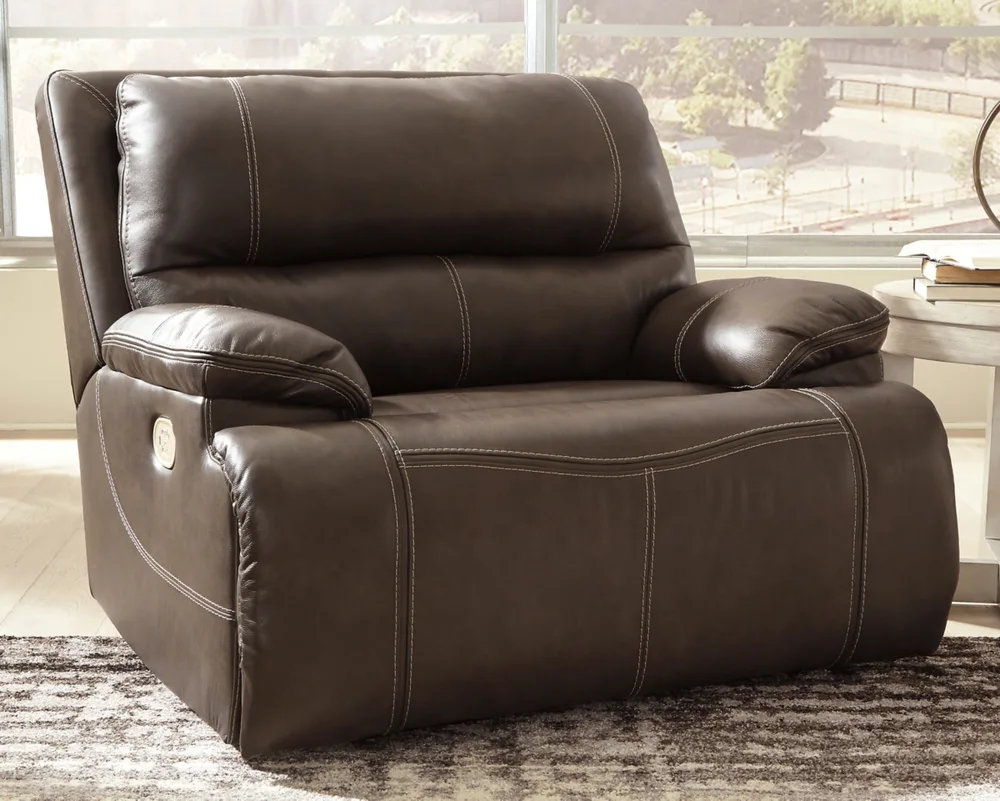
Leather match sounds like a color-coordination term. What it means is that the leather stops where your body does. Ashley’s Ricmen power recliner is the textbook case: real leather covers the seating areas, while the outside back and side panels wear vinyl and polyester dyed to match. Nothing about this is hidden, since the materials breakdown spells it out, but the shorthand of a leather recliner does a lot of work in the headline. Leather match shows up even on chairs in the $1,500 to $2,000 range, so a healthy price is no guarantee of hide on every panel. Decide whether you care. A recliner that sits near a wall shows its vinyl to nobody, and the money saved is real. A chair floating in the middle of a room is a different calculation.
Bonded leather, the one to avoid
Bonded leather is the label to walk away from. It is ground leather scraps glued to a fabric backing, then finished to look like hide. On high-contact seating, bonded leather is widely reported to peel and crack within roughly two to five years, and a recliner is nothing but high contact: arms, seat, back, and headrest all flex every time the mechanism moves. Bonded leather exists so a maker can put the word leather on a cheap chair, and that is the entire point of it.
Honest faux, when synthetic makes sense
Clearly labeled synthetics are a different story. MCombo covers its widely sold 7040 lift recliner line in faux leather, with fabric variants, and the result lands in the $500 to $600 range. Nobody is pretending. You give up the aging character of real hide, since faux wears out rather than breaking in, but you also skip bonded leather’s peel-and-crack failure mode and most of the price. For a chair that will see hard daily use and eventual replacement, or a household with pets and kids, an honest synthetic can be the rational pick.
How to read a listing in five minutes
A short routine protects you. Find the full materials breakdown rather than trusting the headline; every reputable listing has one. Look for the qualifier attached to the word leather: top grain, semi-aniline, match, bonded, PU, faux. If no qualifier appears, ask the seller directly what covers the outside back and side panels, because that is where substitutions hide. Treat the phrase genuine leather with mild suspicion too, since it is technically true of low-grade cuts. Finally, let price inform your read. Recliners run from the mid-hundreds to well past three thousand dollars, and full top-grain upholstery does not live at the bottom of that range.
Care rules, whichever grade you buy
The care requirements are stricter than most owners expect. Ashley’s published guidance for genuine leather: keep the chair out of direct sunlight and at least two feet from heat sources or vents, skip abrasives, saddle soap, and household cleaners entirely, and test any cleaning product in a hidden spot first. That last point has teeth, because improper cleaning can void the warranty. Flexsteel’s guidance hits the same themes for its upholstery: wipe spills immediately with a soft damp cloth and keep furniture away from damp areas and heating or AC vents. None of this is difficult. It needs to happen from day one, though, because sun fade and cleaner damage do not reverse.
Questions, answered once
What does leather match mean on a recliner listing?
It means real leather on the seating surfaces and a synthetic, usually vinyl or polyester, on the outside back and sides. Ashley's Ricmen is a typical example. The construction is legitimate when disclosed, but the headline word leather does not apply to every panel.
How long does bonded leather last on a recliner?
On high-contact seating, bonded leather is widely reported to peel and crack within roughly two to five years. Every surface of a recliner gets contact and flexing, so it is about the worst furniture type for this material.
Is faux leather worse than bonded leather?
No, and it is usually the better budget choice. Faux leather is an honest synthetic that wears predictably, while bonded leather is ground scraps glued to fabric that tends to peel. Neither ages like real hide, but faux avoids bonded's failure mode.
Can cleaning products void a leather warranty?
They can. Ashley's care guidance warns that improper cleaning may void the warranty, and it specifically rules out abrasives, saddle soap, and household cleaners. Test anything you plan to use in a hidden spot first.